Worlds worth learning.
A playable research-game platform, with game versions, development histories and human review. Synthetic games support research and training—not just a collection of demos.
Explore the games LOGICAL
INDEPENDENT AI RESEARCH & ENGINEERING
Observe. Act. Learn. Repeat.
We build and study agents that learn through interaction—with ARC-3 as our research ground.
Real environments. Inspectable experiments.
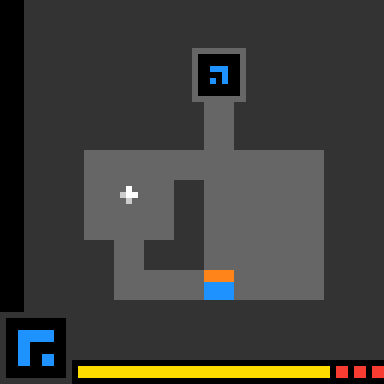
Actual images from our ARC-3 learning guide. Teaching examples, not live agent play.
01 / THE WORK
ARC-3 asks an agent to interact with an unfamiliar visual world. Our work connects the environments, the agent and the tools needed to understand what actually happened.
A playable research-game platform, with game versions, development histories and human review. Synthetic games support research and training—not just a collection of demos.
Explore the gamesVisual, tool-using agents that observe a board, choose actions and work with the consequences. We investigate the harness, memory and interaction loop around the model.
Inspect a recorded actionRun inspection, replay analysis and reproducible experiments. Our internal evaluation tools connect outcomes to the exact model, configuration and recorded run.
Read the public research02 / THE RESEARCH LOOP
In an unfamiliar environment, progress comes from trying something—and noticing what changes. The agent, its tools and the system serving it all matter.
Read the visual state. Identify what is known and what still needs explaining.
Use a tool, try an action, test a hypothesis about how the world works.
Compare the outcome with the expectation. Carry useful evidence forward.
Inspect the whole run. Separate a useful change from a lucky result.
Our harness work builds on Tufa Labs’ Duck Harness, connecting agent experiments, integrations and run analysis.
RECORDED PLAY / BP35
Two moments from a published Astra replay show why we inspect what changed—not just what an agent said it would do.
MOVE 2 / THE FAILED TEST
The character is below a dark ledge. Astra clicks the plain dark wall inside the ring. The wall and character stay in place: no path opens.
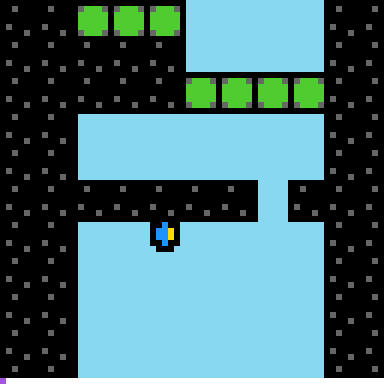
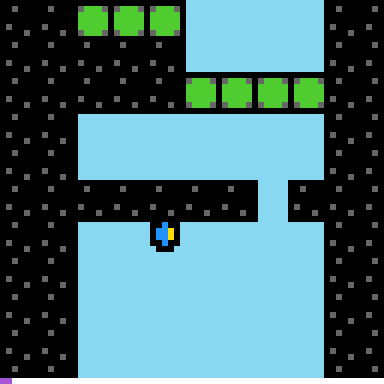
The published note guesses a grappling action. The visible outcome does not support that guess.
MOVE 6 / A DIFFERENT RESULT
Later in the same replay, Astra clicks a green block inside the ring. The block disappears, the character rises into the space above, and the view follows.
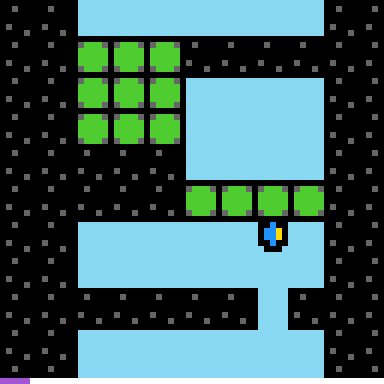
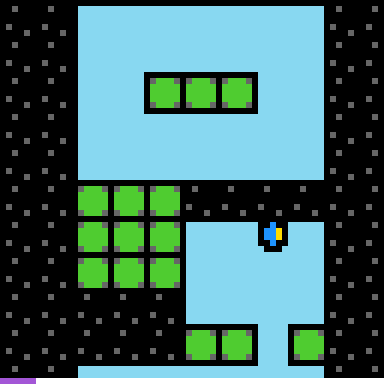
There is no written explanation for this move. The frames establish the change, not how the idea was discovered.
Source: our October 5, 2026 learning-guide analysis of a published Astra replay. These are recorded frames; the descriptions are our analysis of external model play.
03 / OPEN A NOTEBOOK
Go beyond the final score. Explore the games, inspect published replay analysis and see how learning from a run differs from simply ranking it.
Practice images, level-by-level lessons and references back to published play.
Our review of published Astra notes: what they explain, and what remains unresolved.
Dated best-known action records from published ARC Prize results—not claims of optimal play.
These resources include analysis of external models and published human results. Those results belong to their original contributors; the comparison and learning tools are part of our research work.
EXPERIMENT NOTE / SEPTEMBER 22, 2026
We tested whether repeated instructions about how to observe, plan and act were helping a full-history agent. In timed local evaluations, removing that coaching improved overall results in both repeats against the clean-return baseline.
The tempting conclusion—“shorter prompts are better”—did not hold. Further deletions reversed the gain, and the hardest games did not improve consistently.
Scope: 25 games, seven parallel lanes and a fixed 132-minute gameplay budget per run. This historical local experiment is not a current competition score. The lesson is to compare complete runs, repeat the result and keep the unsuccessful variants.
Inspect the evidence at action level ↗04 / UNDER THE HOOD
Inference engineering is part of our ARC-3 work: context and cache behavior, host and kernel performance, and the difference between generating tokens faster and completing more useful work.
We compare serving behavior against real agent workloads, using complete runs to check whether a systems change helps an agent finish useful work.
EXPLORE THE RESEARCH